
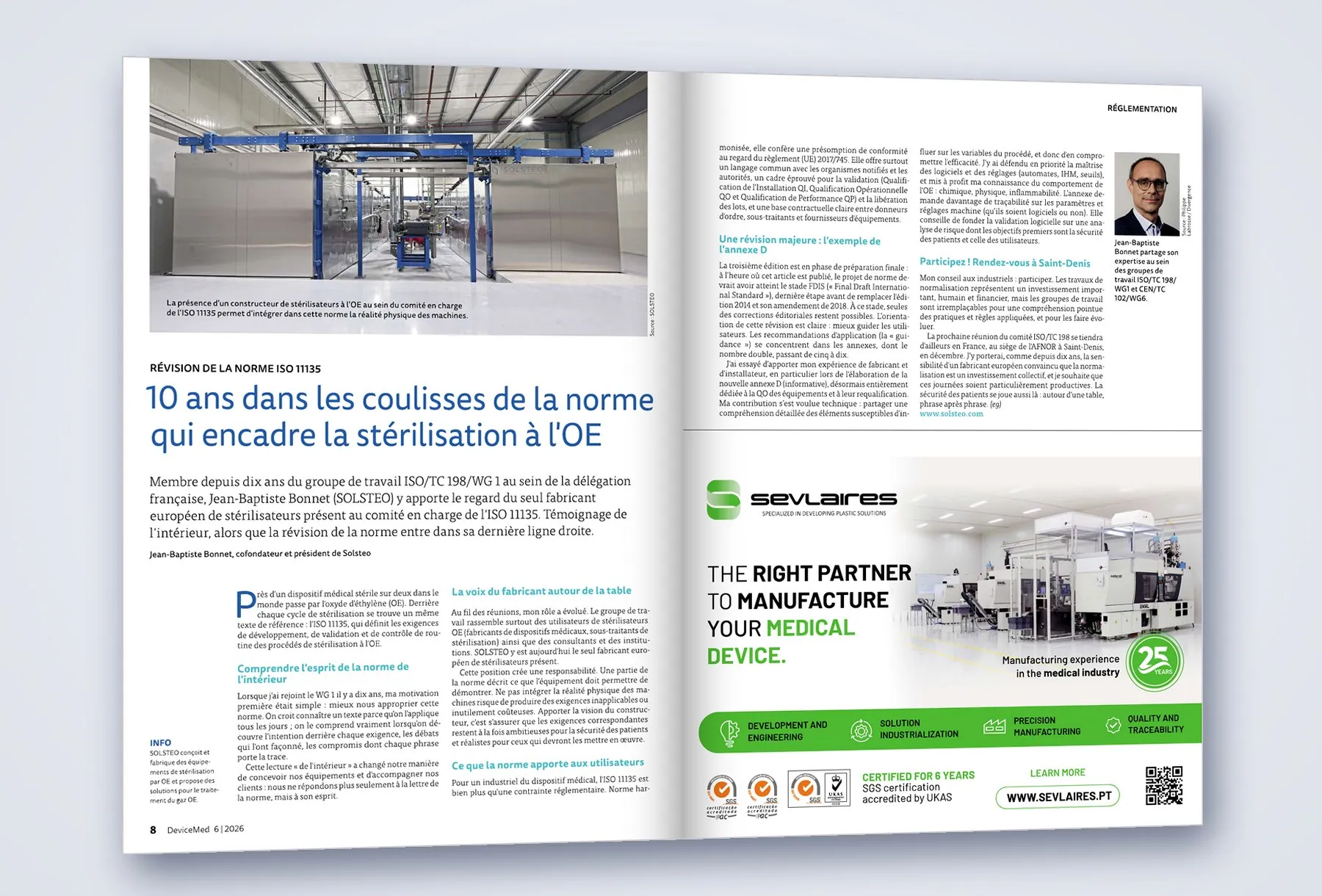
A member for ten years of the ISO/TC 198/WG 1 working group within the French delegation, Jean-Baptiste Bonnet (SOLSTEO) brings the view of the only European sterilizer manufacturer present on the committee in charge of ISO 11135. An insider’s account, as the revision of the standard enters its final stretch.
This article by Jean-Baptiste Bonnet, co-founder and president of SOLSTEO, was published in DeviceMed 6/2026 (November-December 2026), pages 8 and 9, in the “Regulation” section. It is written in French. Here is a summary in English.
Understanding the spirit of the standard from the inside
Nearly one sterile medical device in two in the world goes through ethylene oxide (EO). Behind every sterilization cycle is the same reference text: ISO 11135, which defines the requirements for the development, validation and routine control of EO sterilization processes.
Jean-Baptiste Bonnet joined WG 1 ten years ago with a simple motivation: to better understand the standard. This reading “from the inside” changed the way SOLSTEO designs its equipment and supports its customers: “we no longer only respond to the letter of the standard, but to its spirit.”
The manufacturer’s voice at the table
The working group mostly brings together users of EO sterilizers (medical device manufacturers and sterilization subcontractors), as well as consultants and institutions. SOLSTEO is today the only European sterilizer manufacturer present. Bringing the manufacturer’s vision helps ensure that the requirements stay both ambitious for patient safety and realistic for those who have to implement them.
What the standard brings to users
For a medical device manufacturer, ISO 11135 is much more than a regulatory constraint. As a harmonized standard, it gives a presumption of conformity with Regulation (EU) 2017/745. Above all, it offers a common language with notified bodies and authorities, a proven framework for validation (Installation Qualification IQ, Operational Qualification OQ and Performance Qualification PQ) and for lot release, and a clear contractual basis between sponsors, subcontractors and equipment suppliers.
A major revision: the example of Annex D
The third edition is in its final preparation phase. At the time the article was published, the draft standard should have reached the FDIS (Final Draft International Standard) stage, the last step before replacing the 2014 edition and its 2018 amendment. At this stage, only editorial corrections remain possible. The direction of the revision is clear: to better guide users. The application recommendations (the “guidance”) are concentrated in the annexes, whose number doubles from five to ten.
Jean-Baptiste Bonnet brought his experience as a manufacturer and installer, in particular to the writing of the new Annex D (informative), now entirely dedicated to the OQ of equipment and its requalification. His contribution was technical: sharing a detailed understanding of the elements likely to influence the process variables, and therefore its efficacy. He defended the control of software and settings (PLCs, HMIs, thresholds) as a priority, and drew on his knowledge of how EO behaves: chemistry, physics, flammability. The annex asks for more traceability on machine parameters and settings, whether software-based or not, and advises basing software validation on a risk analysis whose primary objectives are the safety of patients and of users.
Take part! See you in Saint-Denis
His advice to manufacturers and users: take part. Standardization work represents a significant human and financial investment, but the working groups are irreplaceable for a sharp understanding of the practices and rules applied, and for making them evolve.
The next meeting of the ISO/TC 198 committee will take place in France, at the AFNOR headquarters in Saint-Denis, in December. Jean-Baptiste Bonnet will bring, as he has for ten years, the sensitivity of a European manufacturer convinced that standardization is a collective investment.